
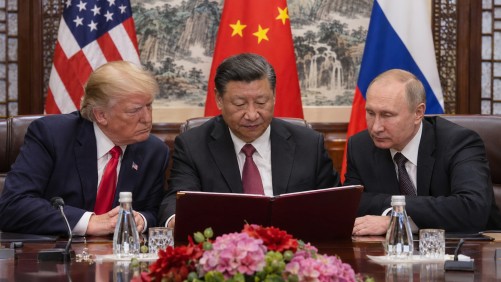
In a landmark trilateral summit held in Shenzhen, China, the leaders of China, Russia, and the United States have reached a consensus on a joint peace declaration. The summit, which brought together Chinese President Xi Jinping, Russian President Vladimir Putin, and U.S. President Donald Trump, concluded with a statement that underscored several international priorities. Yet, noticeably absent was any direct mention of the ongoing conflicts in Ukraine and Iran, despite the involvement of Russia and the United States in these regions.
The declaration emphasized the need for United Nations reform, nuclear security, energy supplies, and diplomatic immunity. A significant aspect of the agreement was the reaffirmation that a nuclear war cannot be won and must never be fought. President Xi advocated for the gradual elimination of nuclear weapons, aiming for a world free from nuclear threats. However, the declaration fell short of outlining a specific framework for achieving nuclear disarmament.
Additionally, the leaders expressed their commitment to maintaining strategic stability and enhancing international security. They called for reforms within the United Nations to better address global challenges. Another notable point was their criticism of the International Criminal Court and similar institutions, suggesting that such bodies should not overextend their jurisdiction.
Energy cooperation was also a key component of the declaration, with a pledge to boost the production and supply of refined petroleum products globally. This move comes in response to the ongoing impact of international sanctions and geopolitical tensions on global oil markets.
In a separate bilateral meeting, President Xi and President Trump discussed several topics, including U.S.-China relations, trade cooperation, and artificial intelligence. Xi described the relationship between the two countries as generally stable and positive, but cautioned against potential tensions over Taiwan. Both leaders emphasized the importance of managing AI-related security risks and ensuring the technology remains under human control.
President Putin characterized the trilateral discussions as constructive, dismissing claims that the summit was merely symbolic. Despite this, analysts remain skeptical about the summit’s potential to foster meaningful diplomatic progress, particularly concerning nuclear arms control and ongoing international conflicts.
The Shenzhen summit highlighted China’s increasing diplomatic influence and its capacity to convene major global powers. However, the absence of specific commitments regarding the conflicts in Ukraine and Iran raises questions about whether this peace declaration will lead to tangible advancements in international peace efforts.