
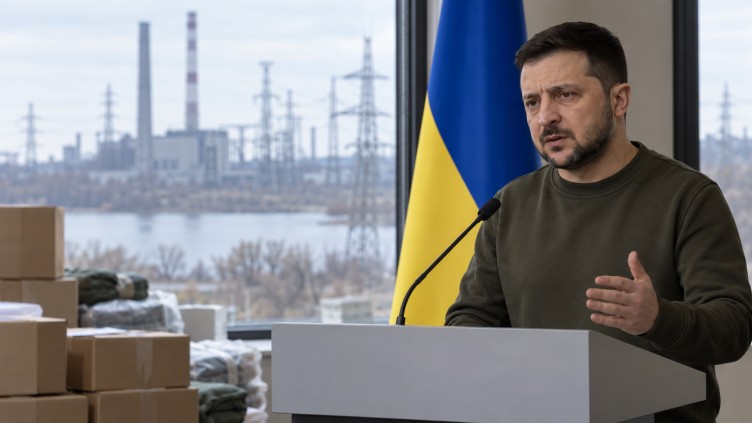
Ukrainian President Volodymyr Zelensky has announced that Russia rejected a proposed energy ceasefire, continuing its attacks on Ukraine’s energy infrastructure. Despite this setback, Zelensky welcomed the initial signs of progress in a separate US-mediated humanitarian truce in Russian-occupied Oleshky, which began on October 27. This truce aims to facilitate humanitarian efforts, including the evacuation of civilians from the southern Kherson region.
During a joint press conference with Dutch Prime Minister Rob Jetten in The Hague on October 28, Zelensky expressed gratitude to the United States for mediating the humanitarian arrangement, which he hopes will lead to safe evacuations. He also mentioned that Ukraine supported a proposal by US President Donald Trump to halt attacks on energy facilities, a proposal that was not reciprocated by Russia. Zelensky reiterated that Ukraine would continue to respond to Russian aggression targeting its energy infrastructure.
The Ukrainian president also revealed that Kyiv is preparing for another round of trilateral peace talks involving Ukraine, the United States, and Russia. These discussions, set to take place in Abu Dhabi between November 6 and 10, are expected to address ceasefire arrangements, energy infrastructure, maritime security, prisoner exchanges, and the return of Ukrainian children. Zelensky emphasized the importance of technical-level meetings to lay the groundwork for negotiations between national leaders, although no direct meeting with Russian President Vladimir Putin has been scheduled.
Zelensky stressed that any agreement concerning Ukraine’s territorial issues must include Ukraine’s participation and highlighted the necessity of involving European countries in discussions about Ukraine’s security guarantees and broader European security arrangements. He affirmed Ukraine’s commitment to pursuing peace talks, even without European representatives in the initial stages.
In a show of support, the Netherlands announced a €500 million military aid package and €1.2 billion in non-military assistance over the next three years. Dutch Prime Minister Rob Jetten stated that his government is collaborating with international partners to secure additional air-defense interceptors for Ukraine, aiming to bolster the country’s defenses ahead of another winter under the threat of Russian attacks.